I played golf for years without a rangefinder and I genuinely do not know what I was thinking. I was guessing distances based on sprinkler heads, pacing off from 150-yard markers, and convincing myself that “it looks like 160” before chunking a 7-iron into the front bunker. Getting a rangefinder changed everything. Not because it made me a better ball-striker, but because it removed one entire variable from my decision-making. Now I just shoot the flag, get my number, and pick a club. No guessing.
Quick answer: The Bushnell Tour V6 Shift is the best golf rangefinder overall if budget is not a concern. It is fast, reliable, and the slope switch makes it legal for any tournament. If you want the best value, the Precision Pro NX10 gives you slope, a magnetic mount, and vibration feedback for about $200.
The Best Golf Rangefinders — Ranked
Here is the honest breakdown after carrying these around the course. The comparison table below will help you narrow it down fast.
| Rangefinder | Best For | Slope | Vibration | Price |
|---|---|---|---|---|
| Bushnell Tour V6 Shift | Overall | Yes (switchable) | JOLT | about $300 |
| Precision Pro NX10 | Best Value | Yes | Pulse | about $200 |
| Gogogo Sport Vpro GS03 | Budget | Yes | Yes | about $90 |
| Callaway 300 Pro | Beginners | Yes | P.A.T. | about $180 |
| Blue Tees Series 3 Max | Best Display | Yes | Yes | about $230 |
1. Bushnell Tour V6 Shift — Best Overall
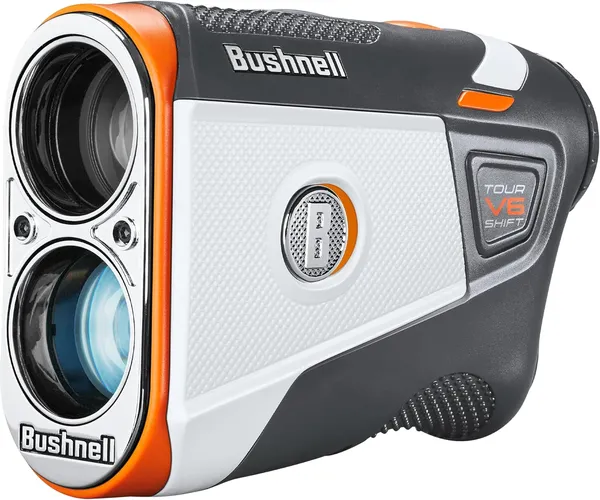
Bushnell is the rangefinder brand you see on tour, and there is a reason for that. The Tour V6 Shift acquires the flag faster than anything else I have used. You point it at the pin, press the button, and the JOLT vibration pulses in your hand within about a second to confirm lock-on. There is no ambiguity about whether you hit the flag or the trees behind it.
The slope switch is the standout feature. Flip it on during casual rounds and you get slope-adjusted distances that account for elevation changes. Flip it off and the rangefinder is fully tournament legal. Some rangefinders require you to swap faceplates or enter a menu to disable slope, but the V6 Shift is a simple physical switch on the side. That matters when you are standing on the first tee of a tournament and do not want to fumble with settings.
The 6x magnification is clear and crisp, and the overall build quality feels like a premium product. It is also noticeably compact compared to older Bushnell models.
The drawback: at about $300, it is the most expensive option here. If you play tournaments regularly and want the best, it is worth it. If you are a casual weekend golfer, you can get 90% of this performance for less money.
2. Precision Pro NX10 — Best Value
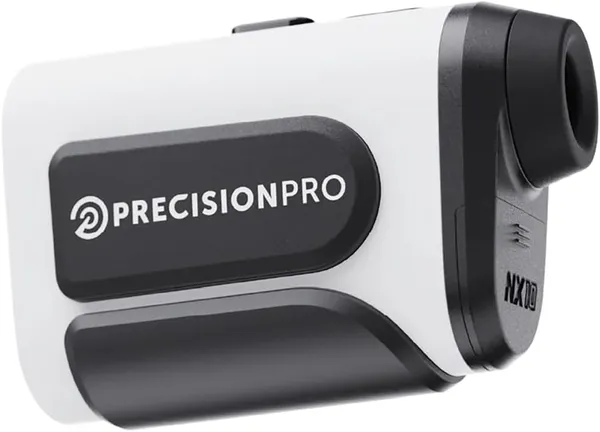
The NX10 is the rangefinder I recommend to most people because it packs nearly every feature you actually need at the $200 price point. Slope, pulse vibration, clear 6x optics, and a magnetic cart mount built into the housing. That magnetic mount is more useful than it sounds — you stick the rangefinder to the cart frame between shots instead of digging it out of a pocket or case every time.
On the course, the NX10 locks onto flags reliably. It is maybe half a second slower than the Bushnell on the initial acquisition, which you will only notice if you are comparing them side by side. For normal play, it feels fast enough. The pulse vibration confirming you hit the flag is a nice touch that removes doubt.
The build does not feel as premium as the Bushnell. The plastic housing is a little lighter, the rubber armor is a little thinner. But functionally it delivers very close to the same performance for $100 less, and that magnetic mount is something the Bushnell does not include.
The drawback: if you want the absolute fastest acquisition and best optics, the Bushnell is still a step up. But for the money, the NX10 is hard to beat.
3. Gogogo Sport Vpro GS03 — Best Budget
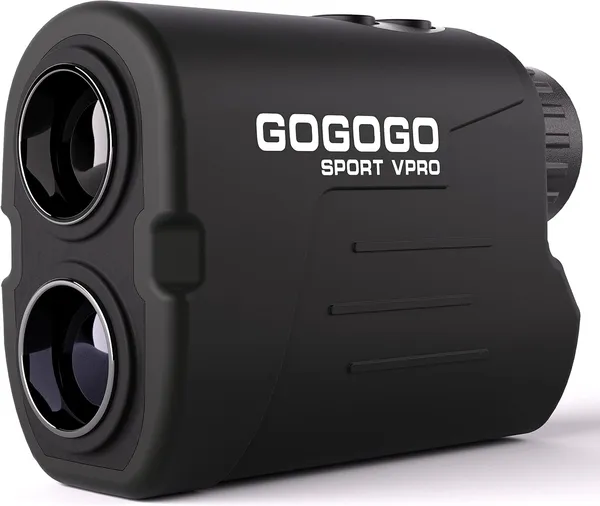
Here is the truth about budget rangefinders in 2026: they are shockingly competent. The GS03 costs about $90 and includes slope, flag lock with vibration confirmation, 6x magnification, and a carrying case. Five years ago you could not get slope for under $200. Now you can get it for under $100.
I was skeptical, but on the course the GS03 gave me readings within 1 yard of my Bushnell on flat approach shots. It nails distances accurately. Where you notice the budget is in the speed — it takes a couple extra seconds to lock the flag, especially if there are trees close behind it. The flag lock vibration helps you know when it has actually found the pin, but you might need to try twice on a few holes where the background is busy.
The case it comes with is basic but functional. The unit itself feels lighter and more plasticky than the mid-range options. If you drop it on a cart path, I would be more worried than I would with a Bushnell.
The drawback: slower acquisition speed and a cheaper build. But the accuracy is there, and for a golfer who wants to stop guessing yardages without spending $200 or more, this is the answer.
4. Callaway 300 Pro — Best for Beginners
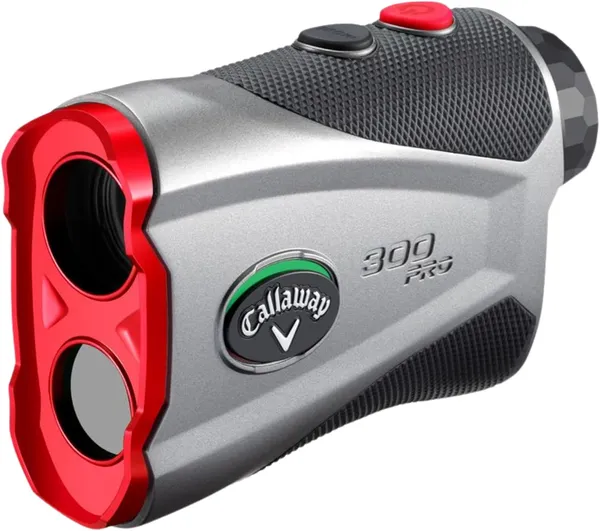
If you have never used a rangefinder before, the Callaway 300 Pro makes the learning curve almost nonexistent. The P.A.T. (Pin Acquisition Technology) is designed to pick up the flag even when you are not holding the unit perfectly steady. Point it in the general direction of the pin, press the button, and it finds it. For newer golfers who are still learning to hold a rangefinder steady, this matters.
The Callaway name carries weight too. This comes with a real warranty and customer support from a company that lives and breathes golf. Slope is included, optics are clean, and the ergonomics are comfortable for any hand size.
The drawback: the maximum range is lower than premium models, which is not a problem for actual golf distances but means it will not reach targets on a par 5 from the tee. It also does not include a magnetic mount, which is something I have come to appreciate having.
5. Blue Tees Series 3 Max — Best Display
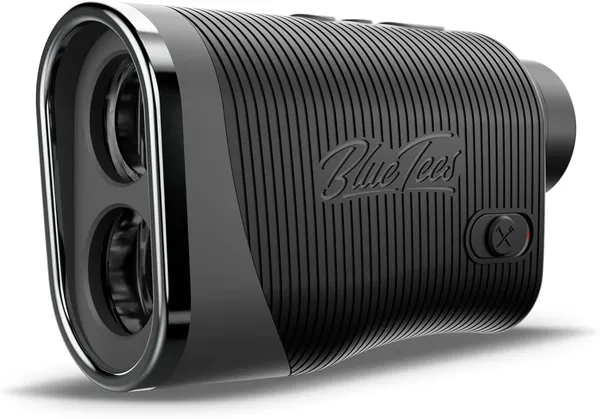
The Series 3 Max has one feature that makes it stand out immediately: the OLED display. Most rangefinders use a standard LCD that can be tough to read in certain lighting. The OLED on the Blue Tees is bright, sharp, and easy to read whether you are in full shade or bright afternoon sun. If you have ever struggled to read the yardage in your viewfinder, this solves that problem.
Beyond the display, it has all the features you would expect at the $230 price point. Slope, a magnetic strip for cart mounting, 900-yard range, and vibration confirmation. The 900-yard range is more than you will ever need on a golf course, but it means the unit has plenty of power to lock onto a flag at 250 yards without hesitation.
The drawback: at about $230, it costs more than the NX10 while offering a similar core feature set. You are paying a premium for that OLED display. In extreme direct sunlight at certain angles, even the OLED can wash out slightly, though it is still better than any LCD in the same conditions.
Do You Really Need Slope?
Slope adjusts your yardage reading based on elevation change. If you are hitting uphill to an elevated green, slope might tell you the pin is playing 158 instead of the flat-line 150. That extra 8 yards changes club selection.
Do you need it? For casual rounds, absolutely yes. It takes the guesswork out of hilly courses and genuinely helps with club selection on elevation changes. I use slope on every casual round and it has saved me from being short on uphill approach shots more times than I can count.
For tournaments, slope is not legal under USGA rules. This is where the Bushnell Tour V6 Shift earns its keep — the physical slope switch lets you disable it instantly. Other rangefinders with slope are technically not tournament legal even if you do not use the feature, unless they have an obvious way to verify slope is turned off.
My advice: get a rangefinder with slope regardless. You will use it in 95% of your rounds. If you play tournaments, make sure it has a verifiable slope-off mode.
Rangefinder vs GPS Watch
I own both, and they serve different purposes. Here is the honest comparison.
A rangefinder gives you exact distance to whatever you point it at — the flag, a bunker, that tree you are trying to carry. It is precise to the yard and gives you specific information about your actual target. The downside is you have to pull it out, aim it, and shoot every time.
A GPS watch gives you front/middle/back distances to the green automatically. You just glance at your wrist. It is faster and easier for general approach shots. But it does not tell you the exact distance to the flag, which could be 10 or 15 yards different from the center of the green depending on pin placement.
I use my GPS watch for tee shots and layup decisions where I need to know how far a hazard is. I use my rangefinder for approach shots where I want the exact flag distance. If I had to pick one, I would pick the rangefinder. Precise flag distances matter more than convenience for scoring.
Frequently Asked Questions
Is slope legal in golf tournaments?
Slope is not legal in most sanctioned tournaments under USGA rules. However, many rangefinders like the Bushnell Tour V6 Shift have a slope switch that disables the feature, making them tournament legal when slope is turned off. For casual rounds, slope is perfectly fine and genuinely helpful.
How accurate are budget golf rangefinders?
Surprisingly accurate. The Gogogo Sport Vpro GS03 at about $90 was consistently within 1 yard of my Bushnell on flat shots. Where budget models fall behind is speed of acquisition and build quality, not accuracy on most shots.
Do rangefinders or GPS watches have better battery life?
A rangefinder battery typically lasts thousands of shots since you only power it on briefly. Most CR2 batteries last a full season of regular play. A GPS watch needs charging every few days depending on usage, which is more maintenance overall.
How do I steady my hand when using a golf rangefinder?
Brace your elbow against your body and use your non-dominant hand to steady the rangefinder. Press the button before you aim rather than aiming then pressing. The JOLT or pulse vibration feature on most modern rangefinders confirms you have locked on the flag, so you do not need a perfectly still hand to get a good reading.
Bottom Line
The best golf rangefinder depends on your budget and how seriously you play:
- Best overall: Bushnell Tour V6 Shift — the fastest, most reliable option with a slope switch for tournament play. Worth it if you play competitively. Check price on Amazon
- Best value: Precision Pro NX10 — slope, magnetic mount, and vibration feedback at $200. The sweet spot for most golfers. Check price on Amazon
- Best budget: Gogogo Sport Vpro GS03 — accurate and feature-packed for under $100. Do not let the price fool you. Check price on Amazon
- Best for beginners: Callaway 300 Pro — easy flag acquisition and a trusted brand. Great first rangefinder. Check price on Amazon
- Best display: Blue Tees Series 3 Max — that OLED screen is legit. If readability matters to you, this is the one. Check price on Amazon
If you are still playing without a rangefinder, just get one. Even the $90 Gogogo will improve your club selection and take the guesswork out of approach shots. It is one of those upgrades where you wonder how you ever played without it.
While you are upgrading your gear, check out our guides on best golf grips for sweaty hands, best golf towels, and best golf gifts for men for more recommendations from stuff I actually use on the course.
Products Mentioned in This Article
Bushnell Tour V6 Shift
Premium laser rangefinder with slope switch for tournament legality, 6x magnification, and JOLT vibration technology for confirmed lock-on.
- Slope switch makes it tournament legal when disabled
- JOLT vibration confirms flag lock-on
- Fast target acquisition
- Trusted brand used on professional tours
- Most expensive option on this list
- No screen stabilization
Precision Pro NX10
Feature-packed rangefinder with slope, magnetic cart mount, pulse vibration, and 6x magnification at a $200 price point.
- Magnetic cart mount included
- Slope at the $200 price point
- Pulse vibration for flag confirmation
- Clear optics with 6x magnification
- Slightly slower acquisition than Bushnell
- Less premium feel in hand
Gogogo Sport Vpro GS03
Budget-friendly rangefinder with 650 yard range, slope, flag lock with vibration, and 6x magnification for under $100.
- Under $100 with slope included
- Surprisingly accurate on the course
- Flag lock vibration confirms target
- Comes with carrying case
- Slower to lock on than premium models
- Feels cheaper in hand
- Battery life shorter than competitors
Callaway 300 Pro
Beginner-friendly rangefinder with slope, P.A.T. (Pin Acquisition Technology), and 6x magnification from a trusted golf brand.
- Easy to use right out of the box
- P.A.T. locks onto flags quickly
- Slope included at mid-range price
- Callaway brand quality and warranty
- Max range lower than premium models
- No magnetic mount included
Blue Tees Series 3 Max
Rangefinder with bright OLED display, slope, magnetic strip for cart mounting, and 900 yard range.
- Bright OLED display readable in any lighting
- Magnetic strip for easy cart mounting
- 900 yard range
- Slope included
- Pricier than NX10 for similar core features
- OLED can be hard to see in extreme direct sun