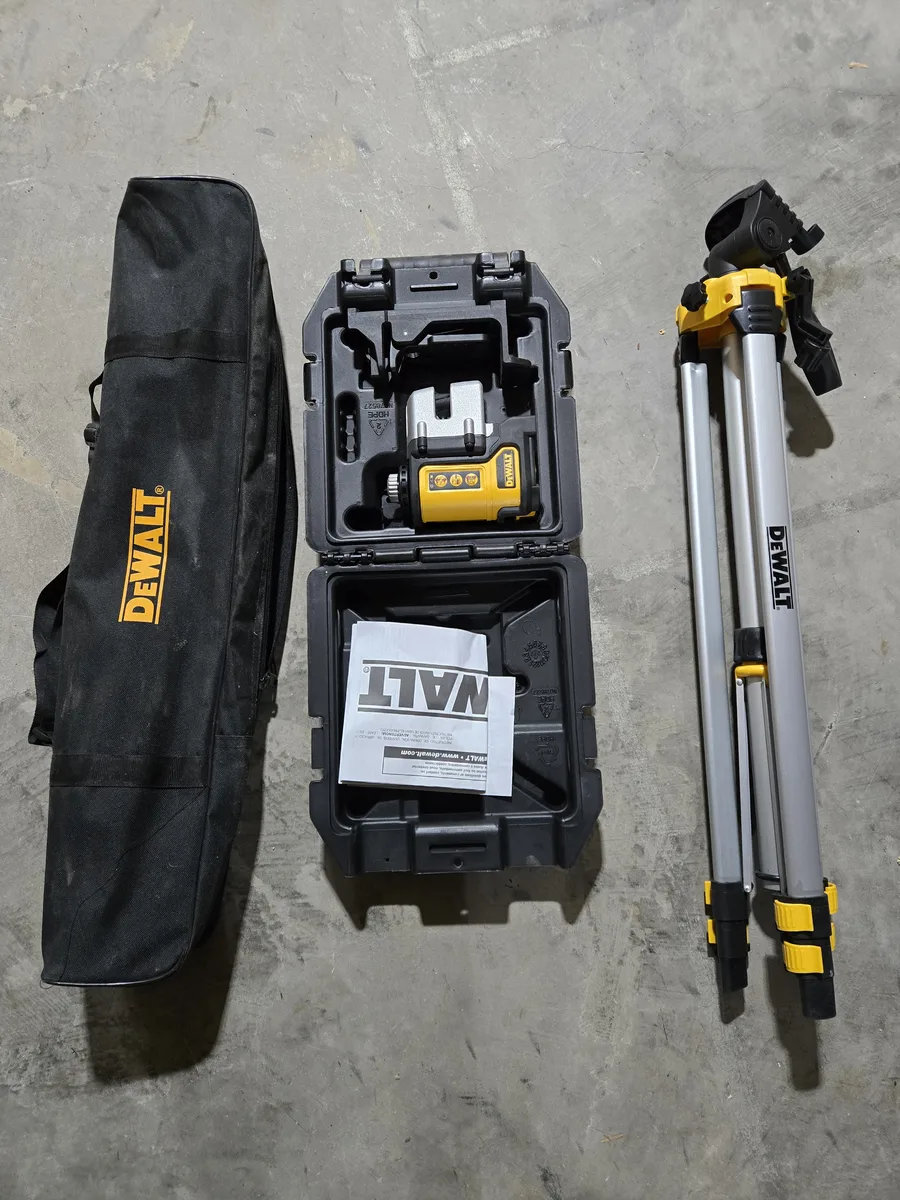
I bought a DeWalt DW0822CG self-leveling laser level a few years ago, and it’s one of those tools I didn’t know I needed until I had one. I’ve used it on everything from hanging pictures and shelves to leveling deck boards and aligning fence posts.
But here’s the honest truth: for just hanging pictures, my laser level is way more than you need. It’s a professional-grade cross-line laser at a professional-grade price. If all you’re doing is hanging frames and the occasional shelf, you can get a perfectly good self-leveling laser for $30-50.
That said, let me show you why a laser level — at any price point — beats every other method for getting things straight on your walls.
Before I had a laser level, I used a tape measure and a bubble level like everyone else. Measure from the ceiling, mark two points, draw a pencil line, hold the frame up, adjust, re-measure because it still looks crooked…
Before I had a laser level, I used a tape measure and a bubble level like everyone else. Measure from the ceiling, mark two points, draw a pencil line, hold the frame up, adjust, re-measure because it still looks crooked…
A self-leveling laser level eliminates all of that. You set it on a surface (or a tripod), turn it on, and it projects a perfectly level line across your wall. No measuring, no pencil marks, no second-guessing. Put a nail where the laser line is and hang the picture. Done.
The “self-leveling” part matters. The laser uses an internal pendulum that automatically adjusts to true level within about 4 degrees of tilt. Set it on a slightly uneven table or shelf and it still projects a perfect line. You don’t need to fuss with bubble vials or shim anything.
My Setup: DeWalt DW0822CG
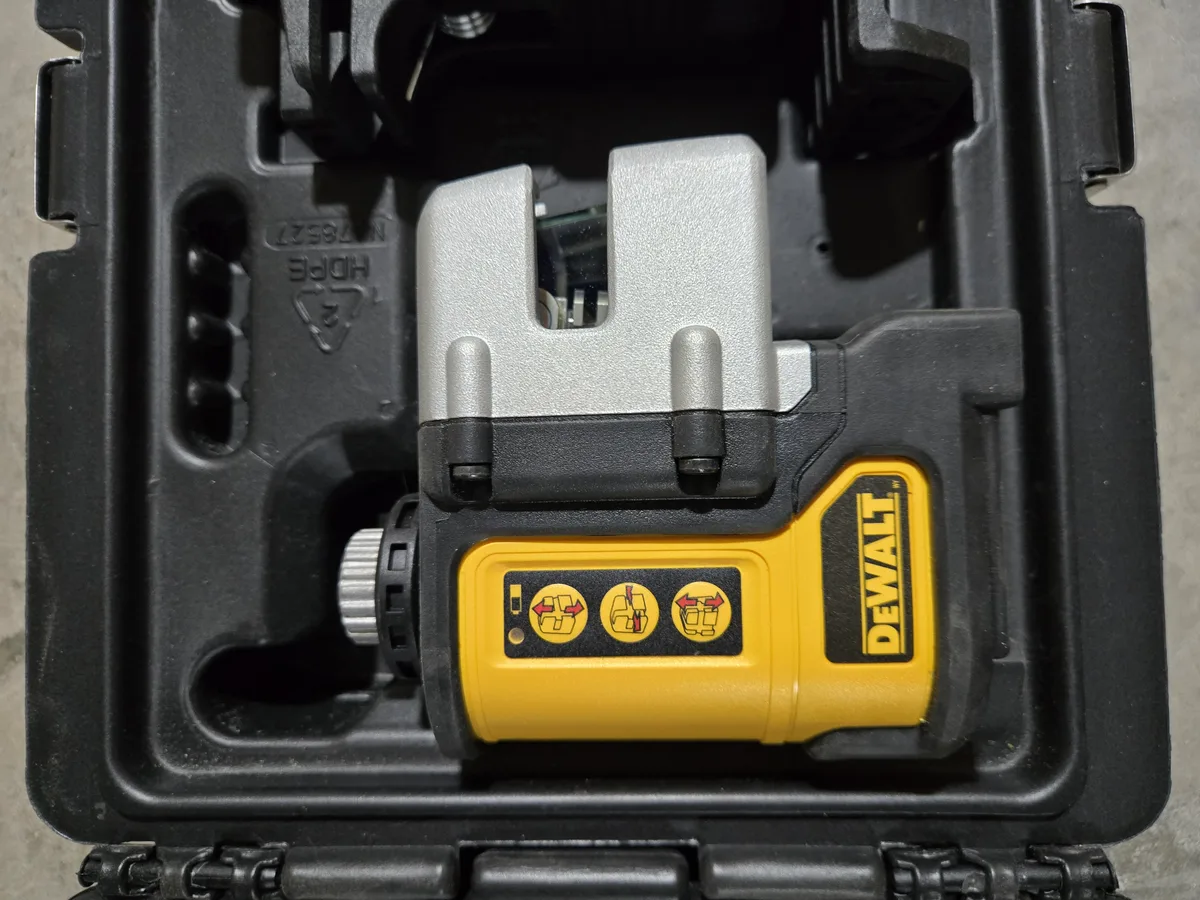
My DeWalt DW0822CG is a cross-line laser, which means it projects both a horizontal and vertical line. The three buttons on the front let you choose:
- Horizontal line only — what you want for pictures and shelves
- Vertical line only — useful for aligning things top to bottom (like tile layout)
- Cross-line mode — both lines at once, creating a perfect cross on the wall
For hanging pictures, you only need the horizontal line. But when I built our deck, the cross-line mode was invaluable for getting posts plumb and boards level at the same time.
The green laser is significantly easier to see than red lasers — about 3-4x more visible to the human eye. In a bright room with the lights on, I can see the green line clearly from across the room. With a red laser, you’d need to dim the lights or get closer.
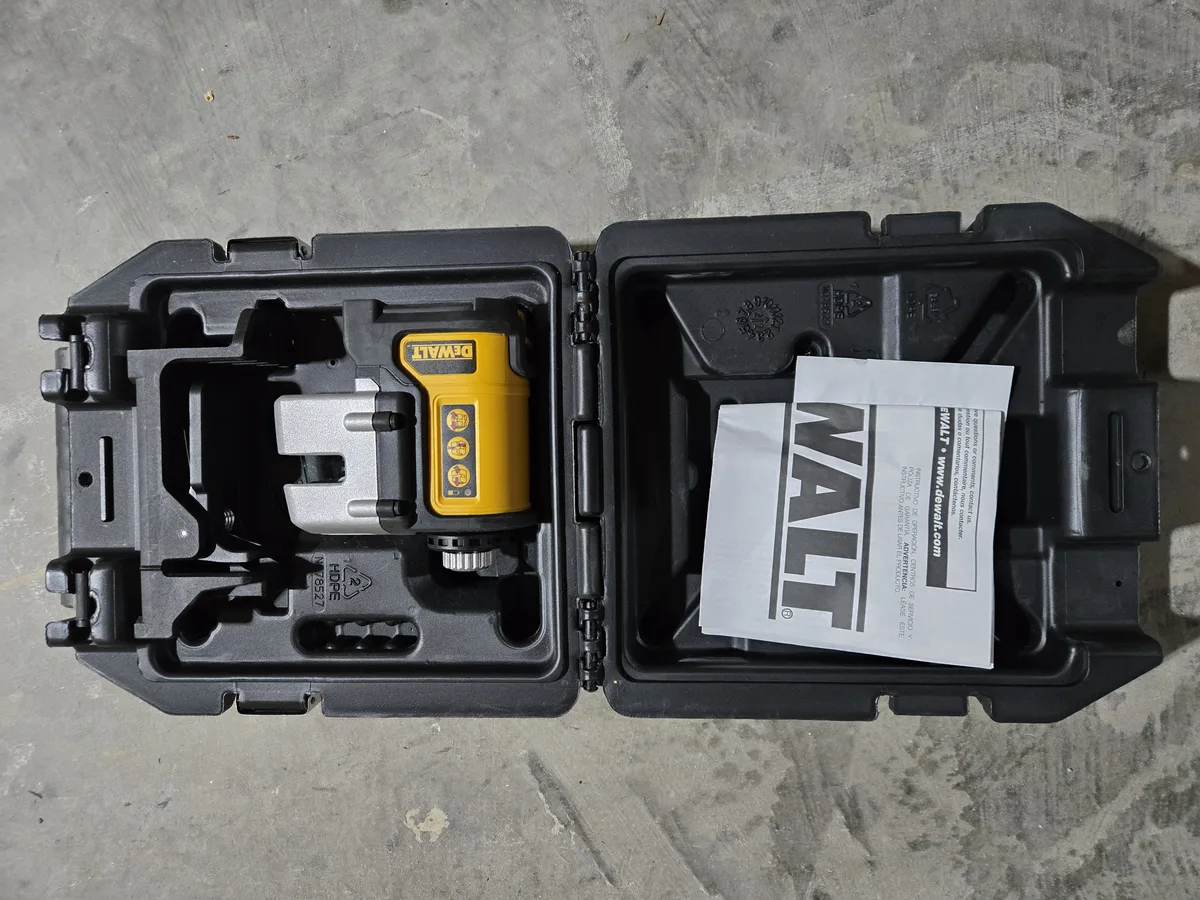
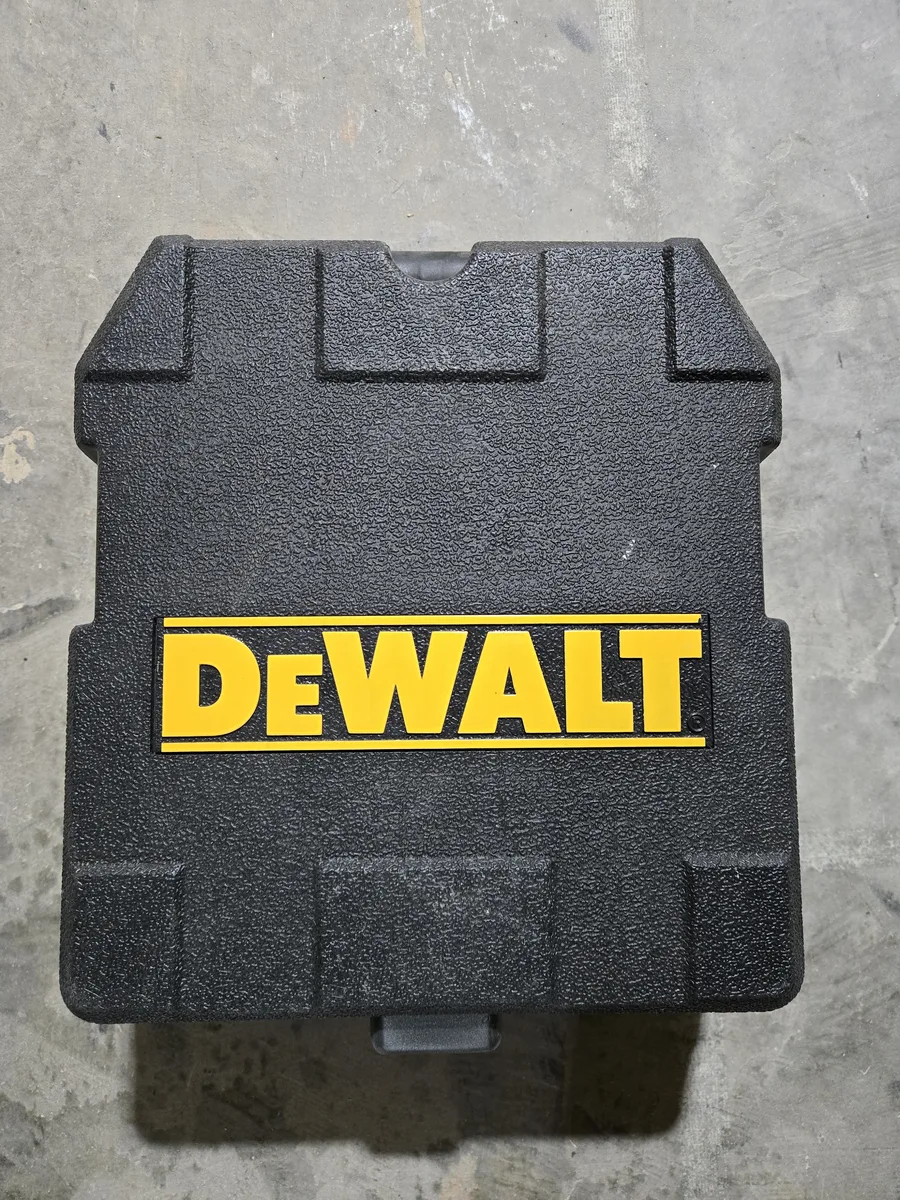
It comes in a solid hard case that keeps everything protected. This thing has lived in my garage for years and still works perfectly.
The Tripod: Nice to Have, Not Required
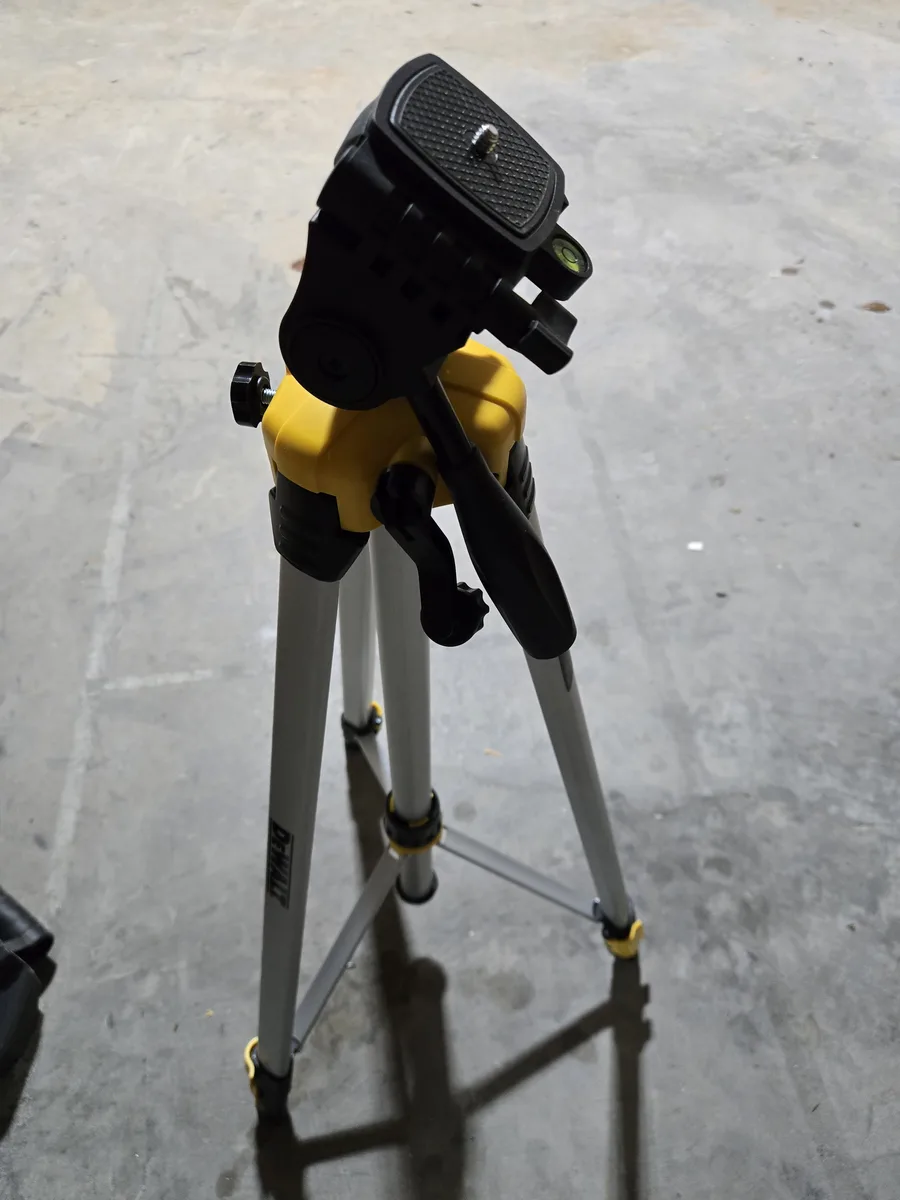
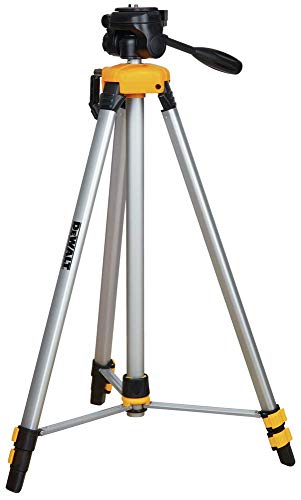
I also bought the DeWalt tripod and it’s useful for bigger projects where I need the laser at a specific height. It extends from about 25 to 60 inches and has a standard 1/4-inch mount.
For hanging pictures, you don’t need a tripod. Just set the laser on a table, shelf, or even a stack of books at roughly the height you want your picture. The self-leveling takes care of the rest. I only break out the tripod for outdoor projects or when I need the laser at a very specific height with nothing nearby to set it on.
Do You Need to Spend This Much?
No. Let me be real about this.
The DeWalt DW0822CG is a professional-grade tool. I use it for construction projects — deck building, garage storage rail installation, fence work. For those jobs, the cross-line capability, green laser visibility, and rugged build quality are worth it.
But if your main use case is hanging pictures, shelves, and maybe a TV mount once in a while, here’s what actually matters:
- Self-leveling — this is the must-have feature. Don’t buy a manual laser level.
- Bright enough to see — green is better, but red works fine indoors.
- Horizontal line projection — that’s the basic feature of any laser level.
Everything else — cross-line mode, spot lasers, outdoor visibility, Bluetooth — is extra. A basic self-leveling laser level in the $30-50 range checks all three boxes above and will do the job perfectly for home use.
How to Hang Pictures With a Laser Level
Here’s the actual process — it takes about 60 seconds per picture:
-
Decide on height. Gallery walls typically center at 57-60 inches from the floor (eye level). For a single piece above furniture, aim for 6-8 inches above the furniture top.
-
Set up the laser. Put it on any flat surface near the wall and turn on the horizontal line. The line appears across the entire wall.
-
Mark your nail points. Hold the picture up to the laser line and mark where the nail needs to go. If you’re hanging multiple pieces in a row, the laser line guarantees they’ll all be at the same height.
-
Check the wall. Before you drill, use a stud finder to see what’s behind the drywall. If you’re hitting a stud, great — use a nail or screw directly. If not, use the right drywall anchor for the weight.
-
Hang it. Nail goes on the laser line, picture goes on the nail. Step back and admire how level it is without measuring anything.
For a gallery wall with multiple frames, this process is a game-changer. The laser line stays visible across the entire wall, so you can space frames evenly and know they’re all perfectly aligned without dozens of pencil marks and measurements.
The Bottom Line
A self-leveling laser level is one of those tools that makes you wonder how you ever lived without it. Hanging pictures goes from a 10-minute measuring-and-marking exercise to a 60-second job.
If you’re a homeowner who hangs the occasional picture or shelf, a basic $30-50 self-leveling laser will serve you well for years. If you’re doing bigger projects — decks, tile, framing, garage organization — that’s where a cross-line model like my DeWalt earns its keep.
Either way, once you’ve used a laser level, you’ll never go back to a tape measure and bubble level for hanging things on walls.
Frequently Asked Questions
What is a self-leveling laser level?
A self-leveling laser level projects a perfectly level line on your wall automatically. You turn it on, set it near the wall, and it adjusts itself within a few degrees. No bubble levels, no pencil marks, no guessing. It's the fastest way to hang pictures, shelves, or anything that needs to be straight.
Do I need an expensive laser level?
For most homeowners hanging pictures and shelves, no. A basic single-line laser level in the $30-50 range does the job perfectly. Cross-line models like the DeWalt DW0822CG are better for bigger projects like deck building or tile work where you need both horizontal and vertical reference lines at the same time.
Is a green laser level better than red?
Green lasers are 3-4x more visible to the human eye than red lasers, especially in bright rooms or outdoors. If you're working in a well-lit room or outside in daylight, green is significantly easier to see. Red lasers work fine in dim rooms but can be hard to spot in bright conditions.
Do I need a tripod for my laser level?
A tripod is helpful for projects where you need the laser at a specific height — like leveling a deck or projecting a line across a long wall. For hanging pictures, you can usually just set the laser on a table, shelf, or even the floor. I'd skip the tripod unless you're doing larger construction projects.
How long do laser level batteries last?
Self-leveling laser levels typically use AA or AAA batteries and last 10-30 hours depending on the model and how many lines you're projecting. My DeWalt runs on AA batteries and lasts a long time since I usually only need it for 15-20 minutes at a time.
Products Mentioned in This Article

DeWalt DW0822CG Cross Line and Spot Laser (Green)
Professional-grade self-leveling cross-line and spot laser with green beam technology. Projects horizontal line, vertical line, or both simultaneously. Accurate to 1/8 inch at 30 feet.
- Self-leveling — no manual adjustments needed
- Green laser is highly visible even in bright rooms
- Cross-line mode projects horizontal and vertical simultaneously
- Built like a tank — survived years of job site use
- Comes in a hard carrying case
- Overkill and overpriced for just hanging pictures
- Heavy — not something you grab casually
- Tripod sold separately
DeWalt Tripod for Laser Levels
Adjustable aluminum tripod designed for DeWalt laser levels. Extends from 25 to 60 inches with a standard 1/4-inch mount.
- Adjustable height from 25 to 60 inches
- Standard 1/4-inch mount fits most laser levels
- Sturdy aluminum construction
- Quick-release plate for easy setup
- Adds cost to an already expensive setup
- Bulky to store