A tape measure is the most-used tool in any toolbox, and somehow also the one people put the least thought into buying. I was guilty of this. For years I used whatever cheap tape was sitting on the shelf at the hardware store, and it worked fine — until it didn’t.
The moment that changed my mind was a shelving project in the garage. I was measuring and cutting plywood for custom shelves, and after three cuts I realized every piece was about 1/8 inch short. The hook on my old tape had gotten bent from being dropped, and every measurement was pulling slightly off. I wasted two sheets of plywood before I figured it out. A $12 mistake because of a $5 tape measure.
Quick answer: The Stanley FATMAX 25ft (about $25) is the best tape measure for most people — wide blade, 11-foot standout, and the BladeArmor coating keeps the hook accurate for years. If you work solo a lot, the Milwaukee 25ft Magnetic (about $28) lets you hook onto metal and measure one-handed. On a budget, the Stanley PowerLock at about $13 has been getting the job done for decades.
The 5 Best Tape Measures
1. Stanley FATMAX 25ft — Best Overall (about $25)
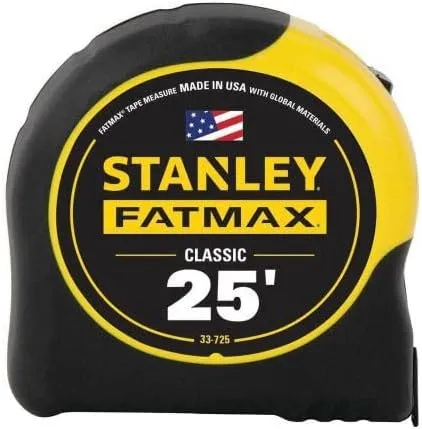
There’s a reason the FATMAX is on every job site in America. The 1-1/4 inch wide blade gives it an 11-foot standout, which means you can extend it across a room without it collapsing. That wide blade also makes the markings easier to read at a distance.
The feature that actually sets it apart is BladeArmor — a coating on the first 6 inches of the blade that protects the hook end from wear. This is where every tape measure eventually fails. You hook it on a board edge, snap it back a thousand times, and the hook gets loose. BladeArmor slows that down significantly.
The rubber overmold grip is another practical touch. I’ve dropped this thing on my garage floor more times than I can count, and the rubber absorbs the impact. The case has dents but the tape still measures true.
It is heavier than compact tapes, and if you’re just measuring for a picture frame, it’s more tape than you need. But for anyone doing regular DIY work, this is the standard for a reason.
2. Milwaukee Magnetic — Best for Solo Work and My Personal Pick
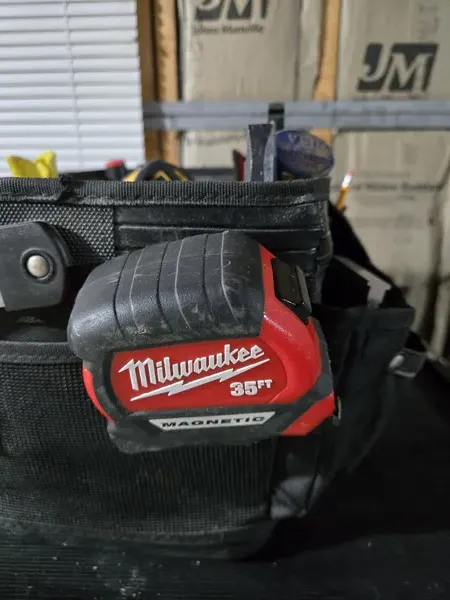
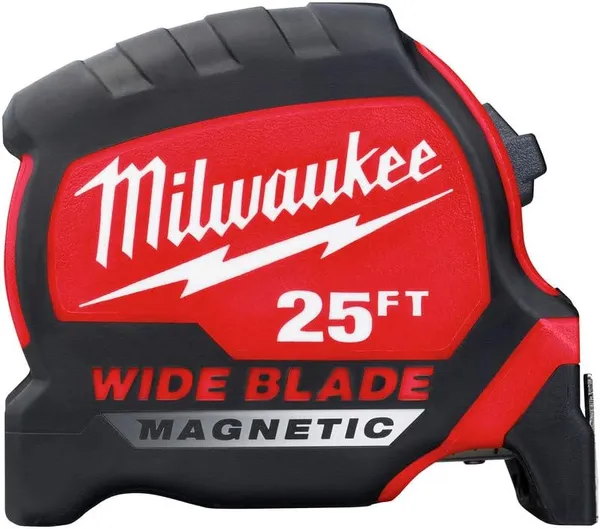
This is the tape measure sitting in my tool bag right now. I have had a Milwaukee Magnetic for years and it has been through more projects than I can count — framing, shelving, drywall, deck work. The rubber overmold is beat up, the case has dents from getting dropped on concrete, and it still measures true. That says everything about the build quality.
If you have ever tried to measure a long distance by yourself, you know the struggle. You hook the tape on one end, walk to the other, and the hook pops off. The Milwaukee solves this with a magnetic hook that grabs onto metal studs, steel brackets, outlet boxes, and ductwork. I use this constantly when I am working solo — hook it to a stud, walk across the room, read the measurement. No helper needed.
It also has the longest standout I have tested at 12 feet. The finger stop lets you lock the blade at any length with one hand, which is great when you are up on a ladder holding a bracket in place. The nylon bond coating on the blade makes it noticeably more resistant to wear than uncoated tapes.
The only real downside is that the magnet picks up metal shavings if you are working around a table saw or doing metalwork. You will occasionally need to clean the hook. The 25ft version runs about $28, and they also make a 35ft version (which is what I use) if you want extra length. The magnetic hook earns that small premium over the FATMAX if you do a lot of solo work.
3. DeWalt ATOMIC 25ft — Best Compact (about $18)
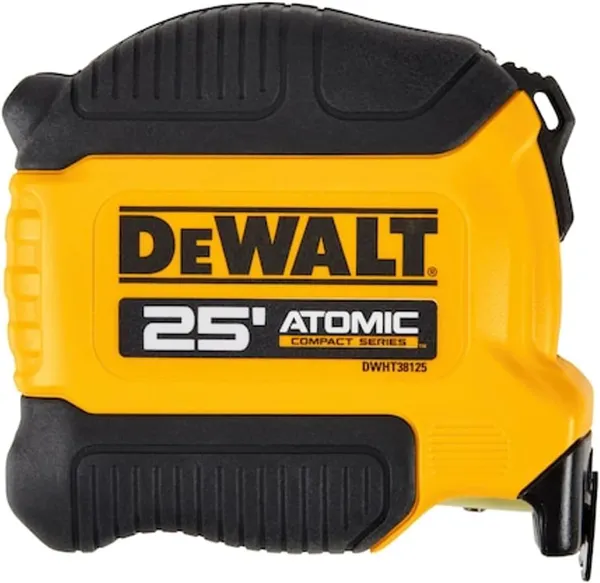
DeWalt managed to fit a full 25-foot tape into a case that’s noticeably smaller than the competition. If you wear your tape on your belt all day, the difference matters. It’s lighter and less bulky without sacrificing the 25-foot length.
The standout feature (besides the compact size) is CenterPoint marking. Every measurement shows a diamond at the center point, so if you’re measuring 14 inches, there’s a mark at 7. Sounds minor, but when you’re centering a shelf bracket or finding the middle of a board, it saves you from doing mental math with fractions.
The trade-off for compact size is a 1-inch blade width (vs. 1-1/4 inch on the FATMAX), which gives it a shorter 10-foot standout. For most homeowner work that’s plenty, but if you’re regularly measuring across rooms solo, you’ll notice the difference.
At about $18, it hits a sweet spot between the budget PowerLock and the premium FATMAX. Great tape if you want something compact that still performs.
4. Stanley PowerLock 25ft — Best Budget (about $13)
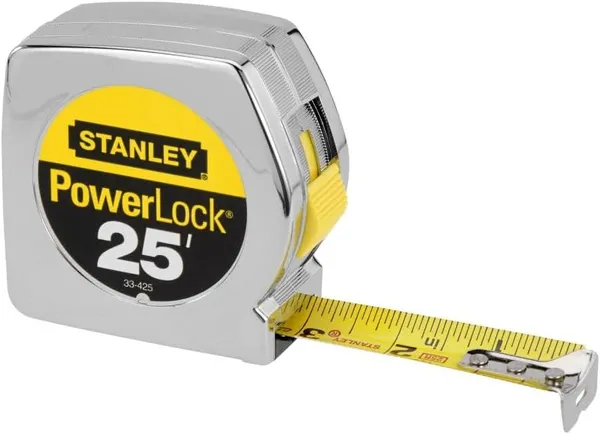
The PowerLock has been around for decades, and there’s a reason it’s still selling. It’s a simple, reliable tape measure that does what it needs to do at a price that makes it almost disposable. Under $15 for a 25-foot tape from a name brand — that’s hard to argue with.
The chrome case is tougher than it looks. The true-zero hook (it slides slightly to account for the hook’s own thickness, giving accurate measurements whether you’re hooking or butting) works like it should. The blade markings are clear and easy to read.
Where it falls short is standout. At 7 feet, you can’t extend it very far before it collapses. The blade is thinner and feels less rigid than the FATMAX. And there’s no rubber grip, so it gets slippery with dusty or sweaty hands.
But here’s the thing — for 95% of homeowner tasks (measuring for curtains, checking if furniture fits, marking a cut line on a board), 7 feet of standout is fine because you’re measuring things within arm’s reach. If that’s your use case, save the money.
5. REEKON T1 Tomahawk — Best Digital (about $99)
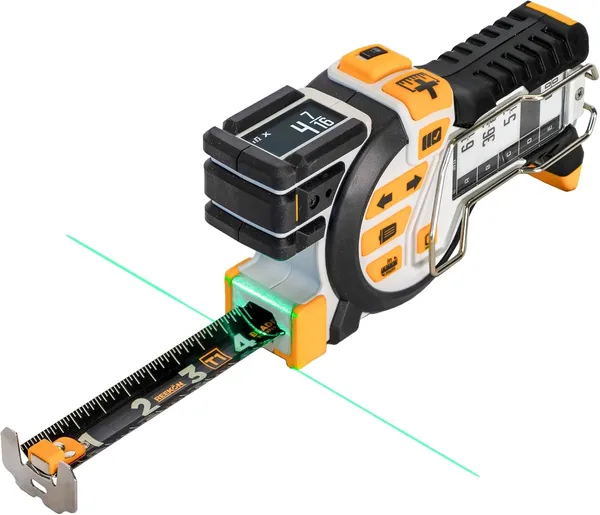
This is the tape measure for people who are tired of squinting at tiny lines and trying to figure out if that mark is 7/16 or 9/16. The REEKON has a digital display right on the tape body that shows your measurement in large, clear numbers. Pull it out, read the screen, done.
It also stores multiple measurements, which is genuinely useful. Instead of measuring, writing it down, climbing down from the ladder, and walking to the saw, you can take three or four measurements and recall them at the saw. It converts between imperial and metric instantly, which is handy if you’re following plans that use either system.
The downsides are real: it costs about $99, which is 4 to 8 times what a regular tape costs. It requires batteries. And for basic measuring — checking a room dimension, marking a cut — a regular tape is faster because there’s nothing to turn on.
Where it shines is repetitive measuring tasks, working with plans that have metric dimensions, and for anyone whose eyesight makes reading 16th-inch marks difficult. If you’re over 50 and doing regular woodworking, this might be worth every penny.
What to Look for in a Tape Measure
Three things matter more than anything else:
Standout distance. This is how far the blade extends horizontally before it bends and falls. Longer standout means you can measure across greater distances solo. The Milwaukee leads at 12 feet, the FATMAX is close at 11, and budget tapes drop to 7 or less. If you work alone often, prioritize standout.
Blade width. Wider blades (1-1/4 inch) are stiffer and give you more standout. They’re also easier to read because the markings have more space. Narrower blades (1 inch or less) make for a more compact tape but sacrifice rigidity.
Hook accuracy. The hook at the end of every tape is designed to slide back and forth slightly — this compensates for the hook’s thickness so you get accurate measurements whether you hook an edge or butt against a surface. A damaged or bent hook throws off every measurement. BladeArmor (Stanley) and nylon coatings (Milwaukee) help the hook last longer. If you drop your tape regularly, this matters.
Do You Need a 25ft or 35ft Tape?
Short answer: 25 feet is enough for almost everyone.
A 25-foot tape measures across any room in a standard house. It’s long enough for framing walls, cutting plywood, and any normal DIY task. A 35-foot tape adds length but also adds weight and bulk — the case is bigger, the belt clip sits heavier, and you’re carrying that extra 10 feet every time you pull it out.
The only scenario where 35 feet makes sense is if you’re regularly measuring exterior dimensions of buildings, laying out foundations, or working on large-scale framing. For those jobs, a 35-foot tape or even a 100-foot reel tape is worth it. For everything else — and I mean everything a homeowner or weekend DIYer does — 25 feet is the right call.
I own a 25-foot FATMAX and have never once wished it was longer.
Product Comparison
| Product | Best For | Standout | Blade Width | Rating | Price |
|---|---|---|---|---|---|
| Stanley FATMAX 25ft | Overall pick | 11 ft | 1-1/4” | 4.8 | $25 |
| Milwaukee 25ft Magnetic | Solo work | 12 ft | 1-1/16” | 4.7 | $28 |
| DeWalt ATOMIC 25ft | Compact carry | 10 ft | 1” | 4.6 | $18 |
| Stanley PowerLock 25ft | Budget pick | 7 ft | 1” | 4.5 | $13 |
| REEKON T1 Tomahawk | Digital readout | — | — | 4.3 | $99 |
What I’d Buy Today
If I were starting fresh with no tape measure, I’d grab the Stanley FATMAX 25ft without hesitation. At about $25, it does everything well — great standout, durable blade, accurate hook — and it’ll last for years of regular use.
If I worked solo on bigger projects, I’d step up to the Milwaukee Magnetic for the hook-and-extend convenience. And if I just needed a tape for occasional household measuring, the Stanley PowerLock at $13 is all you need.
A good tape measure pairs well with the rest of your basic toolkit. Check out our guides on the best stud finder for wall projects, the best cordless drill for driving screws and drilling holes, and the best laser level for hanging pictures for getting things straight on the wall. Measure twice, cut once — but only if your tape is actually accurate.
Products Mentioned in This Article
Stanley FATMAX 25ft Tape Measure
25-foot tape with 1-1/4 inch wide blade, 11-foot standout, and BladeArmor coating on the first 6 inches to prevent hook damage.
- 11-foot standout — best in class for the price
- BladeArmor on first 6 inches prevents hook damage from repeated use
- Rubber grip absorbs drops on concrete and hard floors
- Available everywhere — easy to replace or buy extras
- Heavier than compact tapes
- Can be overkill for light household tasks
Milwaukee 25ft Magnetic Tape Measure
25-foot magnetic tape measure with 12-foot standout, nylon bond blade coating, and finger stop for one-handed operation.
- Magnetic hook holds to metal studs, brackets, and steel beams
- 12-foot standout — the best available in a 25ft tape
- Nylon bond blade coating resists wear and abrasion
- Finger stop allows true one-handed measuring
- Slightly more expensive than non-magnetic tapes
- Magnet can attract metal shavings in the shop
DeWalt ATOMIC 25ft Tape Measure
Compact 25-foot tape measure with CenterPoint marking for easy centering calculations and a tough outer shell.
- Smallest 25ft tape on the market — fits easily on a belt
- CenterPoint marking saves math when centering shelves or artwork
- Tough outer shell survives drops
- Great belt clip that stays put
- Shorter standout than FATMAX at 10 feet
- Blade narrower at 1 inch — less rigid at distance
Stanley PowerLock 25ft Tape Measure
Classic 25-foot tape measure with chrome case, true-zero hook, and proven design that has been a job site staple for decades.
- Under $15 — hard to beat on price
- Proven design that has worked for decades
- Chrome case is surprisingly durable
- Good enough for 95% of homeowner tasks
- Shorter standout at 7 feet
- Blade feels thinner and less rigid than premium tapes
- No rubber grip — slippery when hands are dusty
REEKON T1 Tomahawk Digital Tape Measure
Digital tape measure with an electronic readout that displays measurements, stores values, and converts between metric and imperial units.
- Digital display eliminates misreading marks — no more squinting at 16ths
- Stores multiple measurements so you don't have to write them down
- Converts between metric and imperial instantly
- Great for older eyes or anyone who struggles reading fine gradations
- Expensive at about $100
- Requires batteries
- Overkill for basic homeowner measuring tasks