Every spring, somebody in your neighborhood yanks a starter cord twenty times, mutters, and loads the mower into the truck for a $90 shop visit. The diagnosis is almost always the same: gas that sat in the carburetor all winter and turned to varnish. Winterizing a mower is the twenty minutes of work in the fall that makes it start on the first or second pull in April, and none of it is hard.
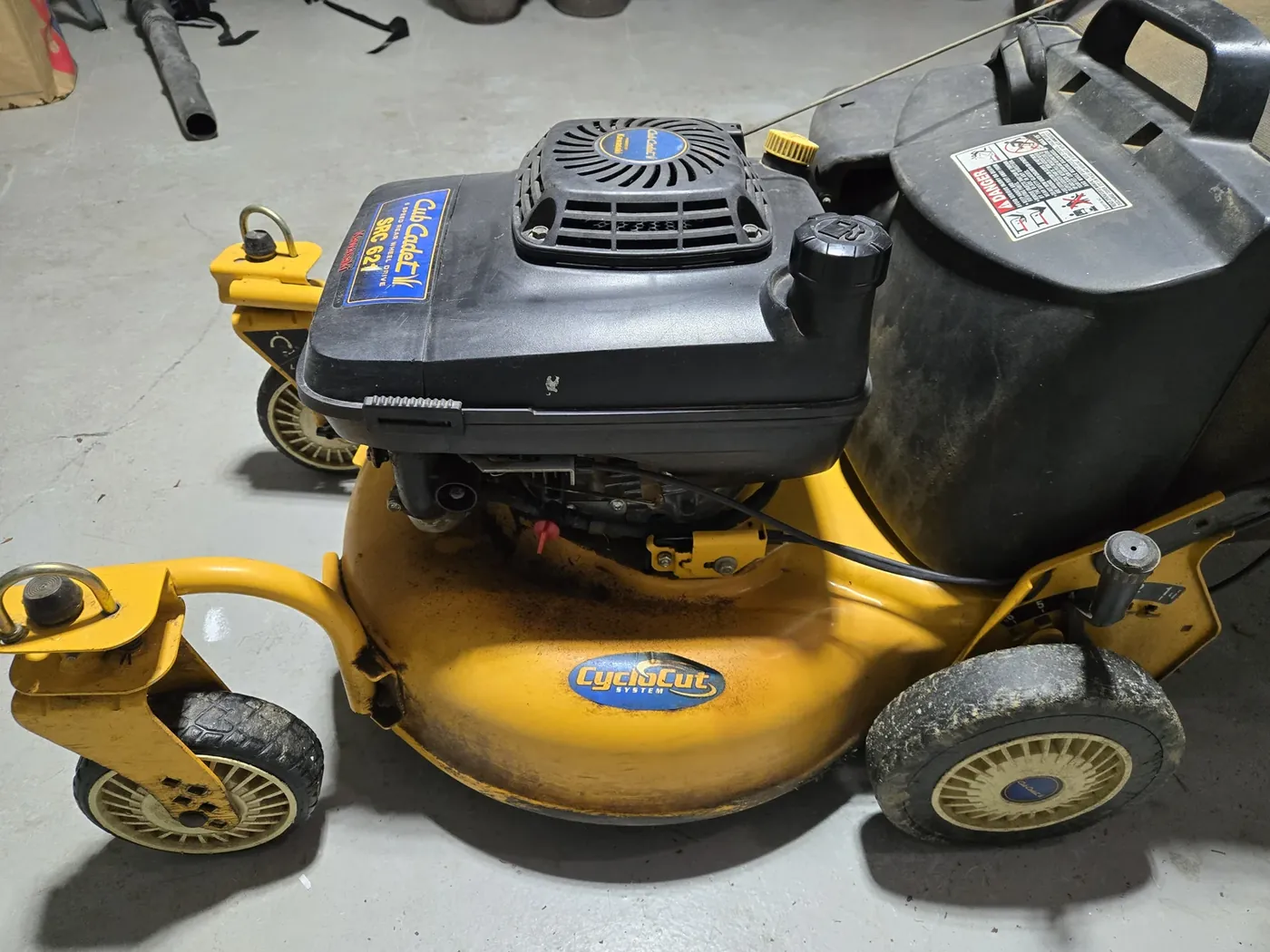
I do this to my Cub Cadet SRC621 after the last mow of the season — here in the Atlanta area the grass doesn’t really quit until sometime in November — and it’s the other half of the routine that starts with the spring tune-up.
The One Decision That Matters: What Happens to the Fuel
Everything else in this job is cleaning and oil. The fuel question is the one people argue about, so here’s the honest version — there are two right answers and one wrong one.
What I do: run it dry. On the last mow of the season I put just enough gas in the tank to finish the job, and let the engine run the tank — and, crucially, the carburetor bowl — empty. When the engine dies from fuel starvation, there’s nothing left in the system to turn to varnish. Nothing to buy, nothing to remember in spring.
The other right answer: store it full, stabilized. Add a storage-grade fuel stabilizer to a fresh tank, run the engine five minutes so treated fuel fills the carburetor, and park it with the tank full. Storage stabilizer keeps gas fresh for up to 24 months; the winter is four. This is the better path if your last mow is unpredictable, if the mower may need to run mid-winter, or if you don’t like running an engine dry.
The wrong answer is the middle one: siphoning or tipping the tank empty and calling it done. A carburetor bowl always keeps a last ounce of fuel, and that unprotected ounce is precisely what evaporates into varnish and plugs the jets — you did the work and kept the failure mode.
Ethanol is the reason any of this matters. Standard E10 pump gas starts degrading in about 30 days: the ethanol pulls water out of the air, the light compounds evaporate, and what’s left gums up passages smaller than a pencil lead. A mower carb is exactly that. My own hedge on top of running dry: I found a station nearby that sells ethanol-free gas, and that’s what my 5-gallon can holds all season — it gums far less, stores far longer, and every small engine I own runs on it. If you keep E10 in your can instead, a dose of stabilizer in the can when you fill it protects the mower, the trimmer, and the can itself in one shot.
What You’ll Need
- Fuel stabilizer — only if you store the tank full instead of running it dry, or to protect the gas that winters over in your can
- A gas can — mine’s a 5-gallon that holds ethanol-free through the season
- SAE 30 or 10W-30 small-engine oil and a drain pan for the fall oil change — same setup as the spring tune-up
- A plastic putty knife or paint stirrer for scraping the deck
- Fogging oil and a spark plug socket — optional, for damp storage (see step 4)
- Rags, gloves, and somewhere dry to park it until spring
Step 1: Deal With the Fuel
The run-dry way (mine):
- Eyeball the last mow of the season and add only enough gas to finish it. A 21” walk-behind burns roughly half a gallon an hour at full throttle, so for a small yard — a half-hour mow — about a quart does it. That’s a third or so of the SRC621’s tank. Err low; running out early costs you a thirty-second walk to the can.
- Mow. If the engine is still running when the lawn is done, let it idle on the driveway until it sputters out on its own. That’s the carburetor bowl emptying — the whole point.
- If it dies mid-lawn instead, you underestimated — pour in a splash and finish. Getting this “wrong” costs nothing.
The stabilizer way:
- On your last fuel run of the season, fill the gas can fresh and add stabilizer to the can at the bottle’s ratio (1 oz per 2.5 gallons for STA-BIL — the built-in dosing chamber measures it). Treating the can covers the mower, the trimmer, and the can itself.
- Top off the mower’s tank with the treated gas. A full tank leaves no air space for condensation.
- Run the engine for five minutes. This is the step people skip, and it’s the whole point — the treated fuel has to actually reach the carburetor bowl. Stabilizer sitting in the tank protects the tank; the carb is where mowers die.
Either way, the gas can itself shouldn’t winter over full of untreated E10 — run it down, treat it, or fill it with ethanol-free.
Step 2: Change the Oil — Fall, Not Spring
Used oil is full of combustion acids and moisture, and the worst thing you can do with it is let it marinate in the crankcase for four months. Changing it in the fall means the engine sits all winter in clean oil and you start spring with zero jobs.
The procedure is the same one from the spring maintenance article: warm the engine a few minutes (that’s already done — it just ran its last mow), pull the spark plug wire, tip and drain into the pan, refill to the dipstick mark with SAE 30 or 10W-30. On the SRC621’s Kawasaki it’s about 18–20 ounces — check your manual.
If you changed the oil recently and it’s still honey-colored, skip this step without guilt. The point is don’t store it on dirty oil, not “change oil twice a year no matter what.” Mine gets its oil changed with the spring tune-up, so at shutdown time I check the dipstick: still honey-colored after a light season, it winters as-is; dark, it gets changed now.
Step 3: Scrape the Deck
Pull the spark plug wire off the plug first — same rule as blade sharpening: if your hand is going near the blade, the engine must not be able to fire. Then tip the mower air-filter-side up and scrape the caked grass off the underside of the deck with a plastic putty knife.
That grass mat is a sponge. It holds moisture against bare, paint-chipped steel for months, and it’s the main way mower decks rust through. Fall is also when it comes off easiest — by spring it’s set like adobe.
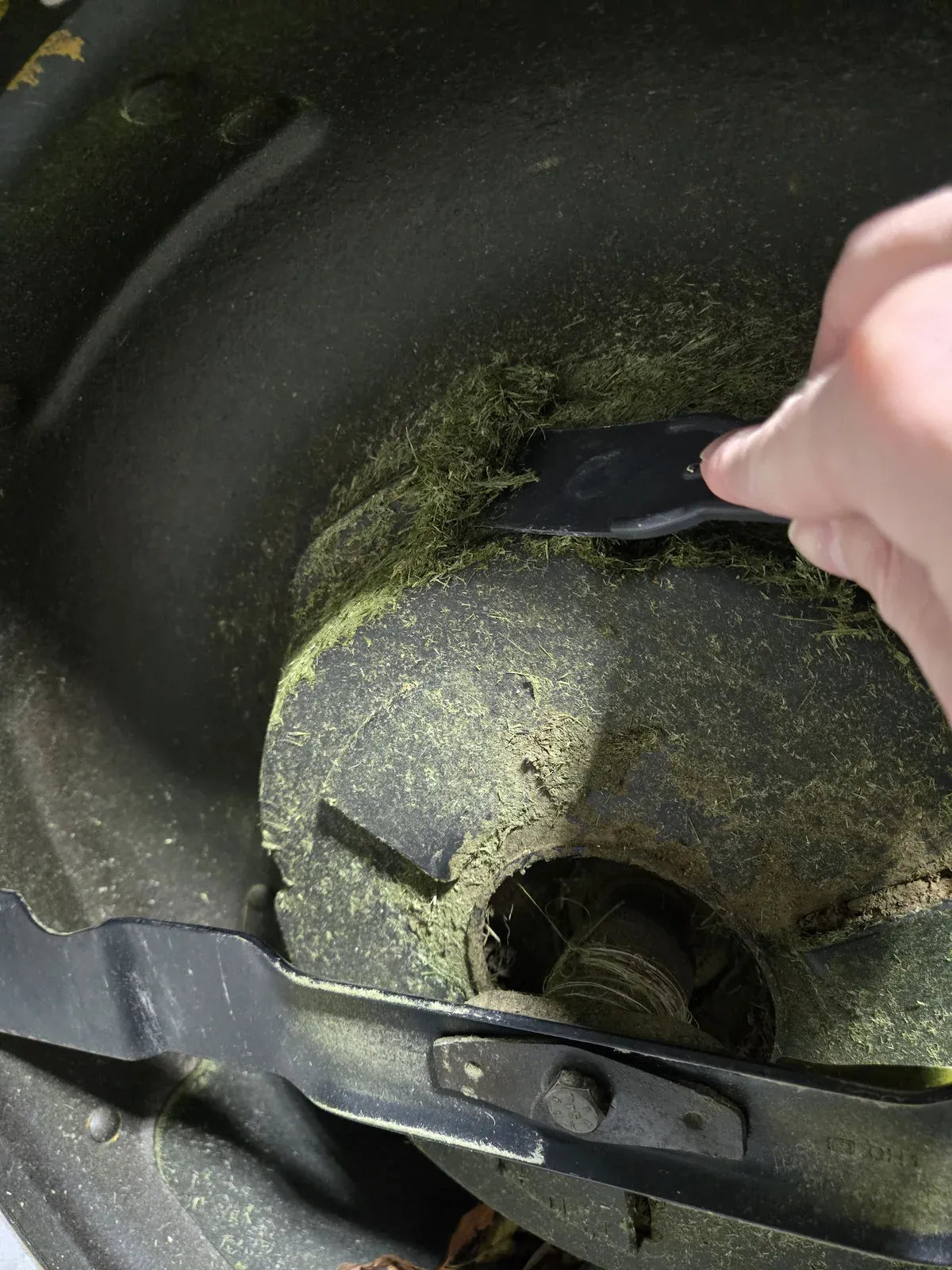
It comes off in satisfying mats once you get an edge under it — this ring around the spindle is a season’s worth:
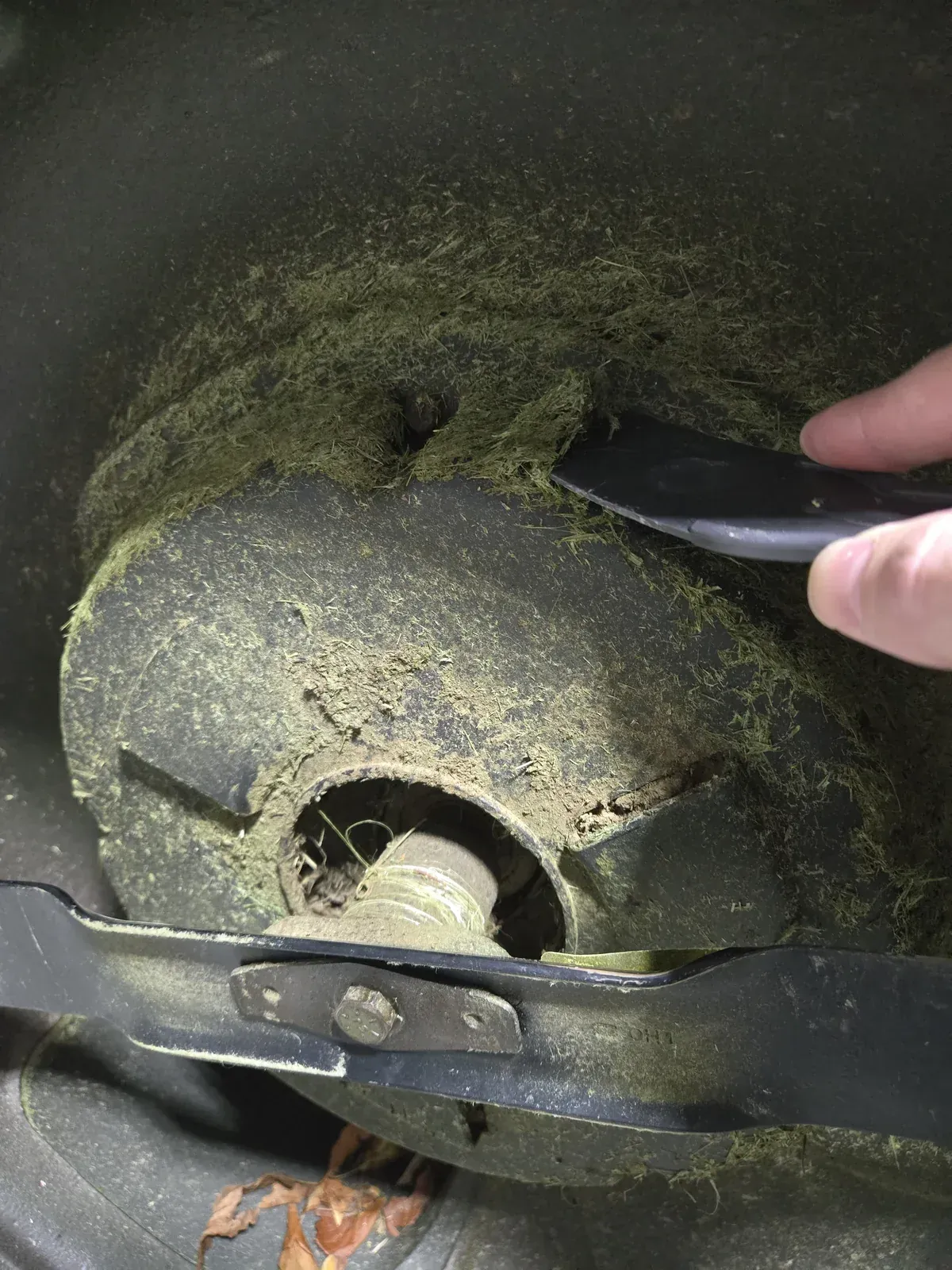
While the mower’s tipped, look at the blade. If it’s dull, this is the moment — the mower’s already apart, and a sharp blade in October means one less job in April. The angle grinder method is here.
Some decks have a hose-port for rinsing; use it during the season, but don’t put the mower away wet. The last cleaning of the year should be a dry scrape.
Step 4: Fog the Cylinder (Optional — I Skip It)
Over a long damp winter, the machined surfaces inside the engine — cylinder wall, piston rings, valve faces — can pick up a film of rust just from the air. Fogging oil is an aerosol that coats them before storage.
I don’t do this one. My mower winters in a dry garage in Atlanta, the off-season is short, and it starts fine every spring without it. Skip it if that describes you too.
Do it if your mower stores in a damp shed, an unheated outbuilding, a humid or coastal climate, or for longer than four or five months:
- Pull the spark plug (5/8” socket on the SRC621).
- Spray fogging oil into the plug hole for a couple of seconds.
- Pull the starter cord slowly two or three times to spread it around the cylinder.
- Reinstall the plug. In spring it’ll smoke for the first thirty seconds — that’s the coating burning off, and it means it worked.
Step 5: Battery, If You Have One
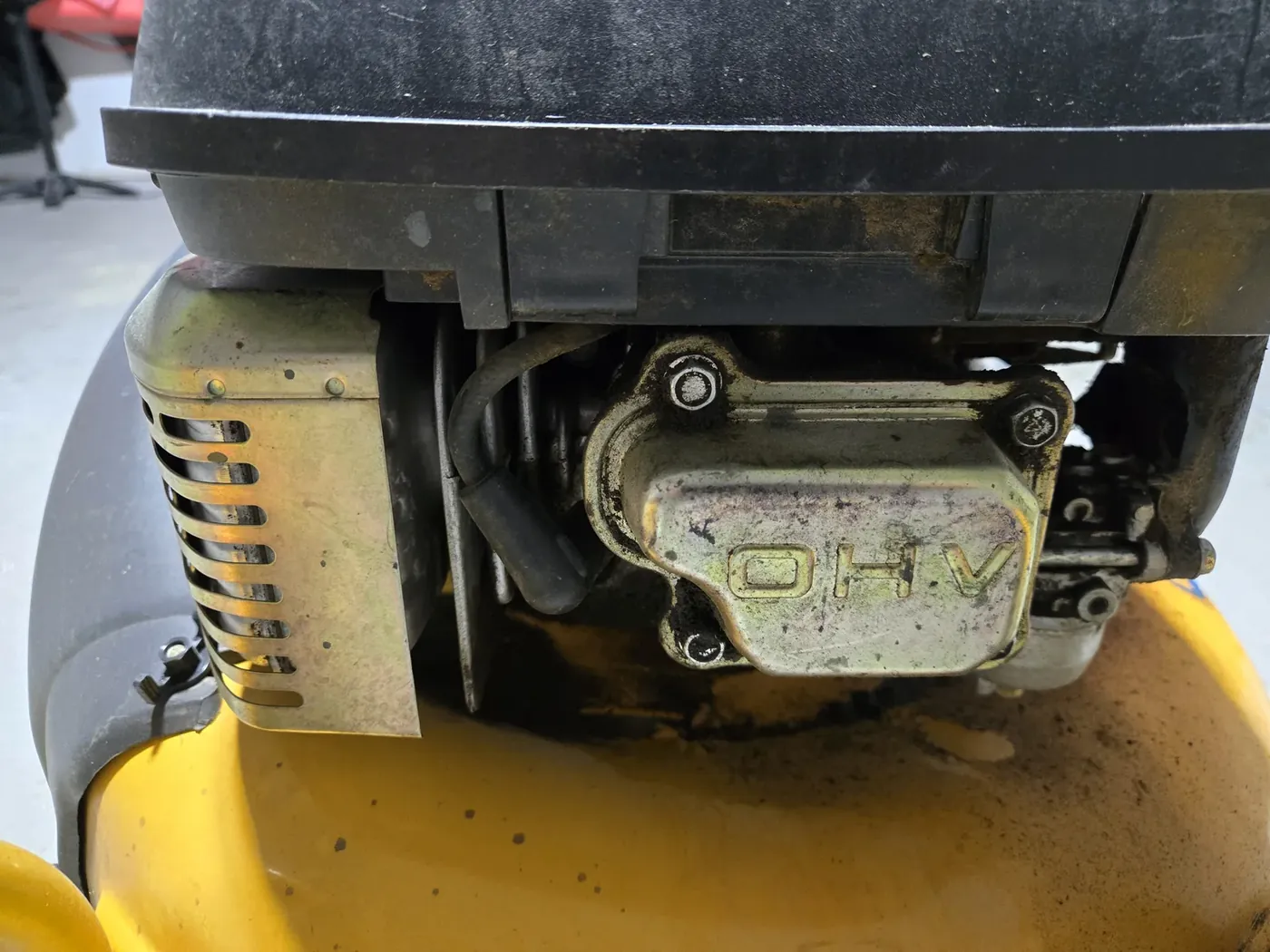
My SRC621 is pull-cord only, so there’s nothing to do here — one of the perks of an old, simple mower. If yours has electric start or is a battery mower, don’t leave the battery dead all winter: charge it fully before storage, store it in a cool-but-not-freezing spot, and top it off once mid-winter. Lithium packs from cordless mowers come inside the house — a hard-frozen lithium battery that gets charged while cold can be permanently damaged.
Step 6: Park It Right
Mine just backs into its corner of the garage — dry, on concrete, uncovered. In Atlanta that’s all the winter protection a mower needs. The general rules, wherever you are:
- Somewhere dry, ideally a garage or shed — off the lawn, off dirt. Concrete is fine.
- Cover it only if it needs covering — a fitted mower cover earns its keep in a dusty shed, under a deck, or anywhere drips reach it. In a clean dry garage it’s unnecessary, and never wrap a mower in a tarp that traps ground moisture underneath.
- Don’t store it next to a furnace, water heater, or wood stove. If you stored it with stabilized fuel, there’s a tank of gas in it. Codes and common sense agree here.
- Get it up against a wall and out of the way — this is the same fall reshuffle where the FastTrack wall system earns its keep, since everything the mower shares the garage with can go up on the wall instead.
Mistakes That Cost People a Carburetor
- Storing it on last summer’s gas, untreated. The #1 cause of no-start springs. If it’s already been sitting a month-plus untreated, run that gas down rather than stabilizing stale fuel — stabilizer preserves fresh gas, it doesn’t resurrect old gas.
- Siphoning the tank and calling it done. The carb bowl keeps its ounce, and now the tank breathes condensation too. Run it dry through the engine, or don’t “drain” at all.
- Stabilizer in the tank, never run. The carb still holds untreated gas. Five minutes of running is the job.
- Storing it filthy. The grass mat under the deck rusts decks through.
- Old oil all winter. Acids and moisture sitting in the crankcase for four months.
- The “it’ll be fine” spring. It usually is fine — twice. The third spring is the $90 carburetor cleaning.
Bottom Line
Run the carburetor dry on the last mow (or store it full of stabilized gas — never the untreated in-between), change the oil so it winters clean, scrape the deck, fog the cylinder if it stores anywhere damp, and park it dry. Twenty minutes in October, first-pull start in April. The spring half of the routine — oil, air filter, plug, blade — is in the seasonal maintenance guide, and if the blade was tearing grass by August, sharpen it now so that job’s done too.
Frequently Asked Questions
Should I drain the gas from my lawn mower for winter?
Don't siphon it out — either run it dry or stabilize it. Running dry means putting just enough gas in for the last mow and letting the engine burn the tank and the carburetor bowl empty, which is what I do. The bad version of "draining" is emptying the tank by hand and stopping there — the carburetor bowl keeps its last ounce, and that untreated ounce is exactly what gums up over winter. The other valid path is storing it full of stabilizer-treated gas after running the treated fuel through for five minutes.
How long does stabilized gas last in a lawn mower?
Untreated pump gas with ethanol starts degrading in about 30 days and can gum a carburetor over a winter. Treated with a storage-grade fuel stabilizer, gas stays fresh for up to 24 months — far longer than any winter. Come spring you just check the oil and start the mower on last year's tank.
Is ethanol-free gas worth it for a lawn mower?
It's meaningfully better for small engines. Ethanol is what pulls water out of the air and what attacks old carburetor rubber, so ethanol-free gas stays usable far longer and gums far less. If a station near you sells it (pure-gas.org keeps a map), running it in the mower, trimmer, and blower all season is cheap insurance — it's what I keep in my gas can. It still isn't a license to store a carburetor wet for six months, but it makes every fuel mistake less costly.
Is it better to change lawn mower oil in the fall or spring?
Fall is better. Used oil holds combustion acids and moisture, and letting that sit in the crankcase for four months is harder on the engine than running it. Change the oil as part of putting the mower away, and in spring it's one less job — you start the season on clean oil.
Do I really need fogging oil for a lawn mower?
For most mowers stored in a dry garage over a normal winter, no — I skip it, and mine starts fine every spring. Fogging oil coats the cylinder wall, piston, and valves so they don't flash-rust while the engine sits, and it earns its two minutes of work in damp unheated sheds, coastal or very humid climates, and any storage stretching past four or five months. If that's your situation, spray it through the spark plug hole before storage and expect a puff of smoke at the first spring start — that's the coating burning off.
When should I winterize my lawn mower?
After the last mow of the season, before the first hard freeze — for most of the US that's late October to Thanksgiving. The practical trigger is grass that has stopped growing. Don't wait until the first snow is in the forecast to discover you're out of stabilizer.
Do I need to clean under the mower deck before storing it?
Scrape it. Caked grass under the deck holds moisture against bare steel all winter, which is how decks rust from the inside out. Pull the spark plug wire, tip the mower with the air filter side up, and scrape the mat off with a plastic putty knife or paint stirrer. Doing it in the fall while it's soft-ish beats chiseling concrete in spring.
Products Mentioned in This Article

STA-BIL Storage Fuel Stabilizer, 16 oz
The standard storage fuel stabilizer. One ounce treats 2.5 gallons and keeps gas fresh up to 24 months. This bottle winterizes the mower, the trimmer, and the gas can for several seasons.
- Treats 40 gallons — one bottle covers every small engine you own for years
- Graduated dosing chamber built into the bottle, no measuring cup
- Works in any gas engine, two-stroke mix included
- Only works on fresh gas — it stabilizes fuel, it doesn't fix gas that's already gone stale

Chapin 78005 12-Quart Low-Profile Oil Drain Pan
12-quart low-profile oil drain pan. The same one from my spring tune-up — the fall oil change is the same job, just at the other end of the season.
- Low profile fits under a tipped walk-behind
- Sealable — stores the used oil until the recycling run
- Larger footprint than slim drain pans — needs a flat spot to sit
Prices shown were retrieved from Amazon on Oct 8, 2026, 2:37 PM UTC. Product prices and availability are accurate as of the date/time indicated and are subject to change. Any price and availability information displayed on Amazon at the time of purchase will apply to the purchase of this product.